


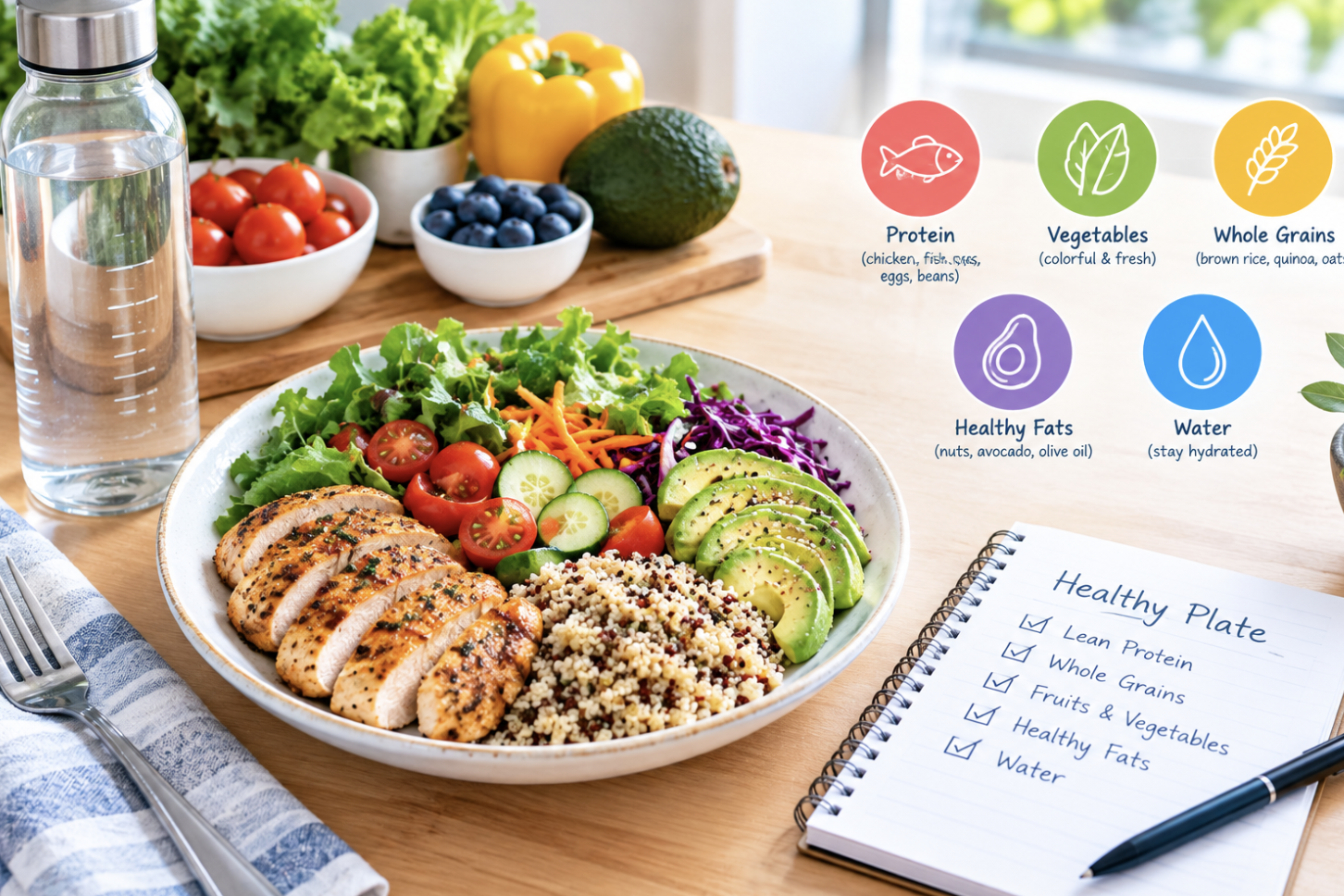
Calorie counting works for some people, but it’s far from the only path toward eating in a way that supports your health and energy levels, and for many people, the level of precise tracking it requires ends up feeling unsustainable over the long run. Learning to build balanced meals based on simple visual and structural principles, rather than exact numerical tracking, offers a more intuitive, sustainable approach that many people find easier to maintain consistently over months and years rather than weeks.
Why a Structural Approach Works
Rather than tracking exact calorie or macronutrient numbers, a structural approach focuses on the general composition and balance of a meal, ensuring it includes adequate protein, fiber-rich carbohydrates, healthy fats, and vegetables in reasonable proportions.
This approach draws on the understanding that meals built with this kind of balance tend to naturally support appropriate portion sizes and satiety, without requiring the mental effort and precision that calorie tracking demands for every single meal.
This doesn’t mean structure and precision are inherently opposed, some people benefit from combining both approaches, but for those who find calorie counting exhausting or unsustainable, a structural approach offers a viable alternative path toward similar underlying health goals.
The Plate Method as a Simple Visual Framework
One of the most widely recommended structural approaches involves mentally dividing your plate into sections: roughly half filled with non-starchy vegetables, a quarter with a protein source, and a quarter with a starchy carbohydrate like rice, potatoes, or whole grains.
This simple visual framework, without requiring any actual measuring or counting, naturally tends to produce meals with reasonable portions of each macronutrient category and a substantial vegetable component that supports overall nutritional adequacy.
This method is intentionally flexible rather than rigid, and adjusting the specific proportions based on your individual activity level, goals, and preferences, more protein if you’re focused on muscle building, for example, or a somewhat larger carbohydrate portion around intense exercise, allows for personalization within the same basic structural framework.
Prioritize Protein at Every Meal
Including a protein source, meat, poultry, fish, eggs, dairy, legumes, tofu, or other plant-based options, at each meal supports satiety more effectively than a meal built primarily around carbohydrates alone, helping you naturally eat appropriate portions without needing to consciously restrict yourself. Protein also plays an important role in maintaining muscle mass, which matters for people at every age and activity level, not just those actively trying to build significant muscle.
Rather than calculating exact protein grams, a reasonable visual guide is including a portion roughly the size of your palm, adjusted somewhat based on the specific protein source’s density and your individual needs, at each main meal.
Don’t Fear Carbohydrates, But Choose Thoughtfully
Carbohydrates have developed something of an unfair reputation in some dietary circles, but they remain an important energy source, and the more useful distinction lies in choosing predominantly fiber-rich, minimally processed carbohydrate sources, whole grains, legumes, vegetables, fruits, over highly refined options most of the time, rather than avoiding carbohydrates as a category entirely.
Fiber-rich carbohydrates digest more slowly, supporting more stable blood sugar and energy levels throughout the day compared to rapidly digesting refined carbohydrates, which tend to produce more pronounced blood sugar spikes followed by corresponding energy dips.
This doesn’t mean refined carbohydrates need to be eliminated entirely, but building your regular meals predominantly around the fiber-rich options, while treating more refined options as occasional inclusions rather than a daily foundation, supports more consistent energy and satiety.
Include Healthy Fats Deliberately
Fat is an essential nutrient that plays important roles in hormone production, nutrient absorption, and satiety, and building a small amount of healthy fat, olive oil, avocado, nuts, seeds, into your meals deliberately, rather than either avoiding fat entirely or consuming it without much awareness, supports both nutritional adequacy and meal satisfaction.
A meal that’s very low in fat, even if it contains adequate protein and carbohydrates, sometimes feels less satisfying and can leave you looking for something additional shortly afterward.
A reasonable visual guide here is a thumb-sized portion of concentrated fat sources like oil or nut butter, or a somewhat larger portion of less concentrated sources like avocado, though this naturally varies based on your specific goals and the overall composition of the rest of your meal.
Build Vegetables Into Every Meal, Not Just Dinner
Vegetables often get concentrated primarily into dinner in many people’s typical eating patterns, but building at least some vegetable content into breakfast and lunch as well provides more consistent fiber, vitamin, and mineral intake throughout the day, along with contributing to the volume and satiety of each individual meal.
This doesn’t require elaborate preparation, adding spinach to a morning scramble, including a side salad with lunch, or simply keeping cut vegetables readily available for easy inclusion, all contribute meaningfully without requiring significant additional effort.
Pay Attention to Hunger and Fullness Cues
Beyond the structural composition of individual meals, learning to recognize and respond to your body’s actual hunger and fullness signals, rather than eating based purely on external cues like the clock or a predetermined portion size regardless of how you’re actually feeling, supports a more intuitive, sustainable relationship with food over time.
This takes practice for many people, particularly those accustomed to strict external rules about eating, but developing this awareness gradually reduces the need for external tracking systems by building internal awareness instead.
Eating slowly enough to actually notice these signals, rather than eating quickly while distracted, matters significantly here, since fullness signals take some time to register, and eating too quickly can mean you’ve already eaten well pas satisfaction before your body has had the chance to communicate that signal clearly.
Adjust Based on Your Actual Activity and Needs
A balanced meal for someone doing intense physical training looks somewhat different than one for someone with a predominantly sedentary day, and adjusting your general portions, more carbohydrates around intense exercise, for example, based on your actual activity level rather than following an identical template regardless of context, supports better alignment between your food intake and your body’s needs on any given day.
This kind of intuitive adjustment becomes easier with practice and attention to how different meals and portions actually make you feel and perform, rather than requiring you to consult external calculations for every situational variation in your daily activity level.
Making This Approach Sustainable
The appeal of a structural, non-counting approach to balanced eating is its sustainability, since it doesn’t require the ongoing mental effort and precision that calorie tracking demands, while still supporting nutritious, well-balanced meals through simple, intuitive visual guidelines.
Building comfort with the plate method, prioritizing protein, choosing predominantly fiber-rich carbohydrates, including healthy fats deliberately, and incorporating vegetables consistently throughout the day creates a framework flexible enough to adapt to your specific preferences, cultural food traditions, and lifestyle, while still reliably supporting nutritional balance without requiring you to track a single number.
Frequently Asked Questions
Can this approach actually work as well as calorie counting for weight management goals?
For many people, yes, since building meals around adequate protein, fiber, and appropriate portions of fat and carbohydrates naturally tends to support appropriate overall intake without requiring precise tracking. Some people do find they need more precision to reach specific goals, and there’s nothing wrong with combining structural principles with some degree of tracking if that works better for your specific situation and goals.
How do I adapt the plate method for meals that don’t naturally separate into these categories, like a stir-fry or a casserole?
The same underlying proportions still apply even when foods are mixed together rather than separated on the plate. Mentally estimating that roughly half the dish’s volume comes from vegetables, a quarter from protein, and a quarter from starchy carbohydrates, even within a single mixed dish, achieves the same balanced composition as the more visually distinct plate method applied to separated food groups.
Is it necessary to include all three macronutrient categories at every single meal?
While including protein, healthy fats, and fiber-rich carbohydrates at most meals generally supports better satiety and nutritional balance, it’s not an absolute requirement for every single meal or snack. Some meals or snacks naturally lean more heavily toward one category, and this is completely fine within the context of an overall day or week that includes reasonable balance across all your meals combined.
What if I’m unsure whether I’m eating appropriate portions without measuring?
Using simple visual comparisons, a protein portion roughly the size of your palm, a fat portion roughly the size of your thumb, can provide useful initial guidance without requiring an actual scale or measuring cups. Over time, most people develop a more intuitive sense of appropriate portions through consistent practice with these visual guidelines, reducing the need for even these simple comparisons as a regular reference point.
Does this approach work for specific dietary patterns like vegetarian, vegan, or gluten-free eating?
Yes, the underlying structural principles apply regardless of specific dietary restrictions or preferences, with the specific foods filling each category simply adjusted to fit your particular dietary approach. Plant-based proteins, gluten-free grains, and dairy-free fat sources can all fill the same structural roles within this framework as their conventional counterparts.
