


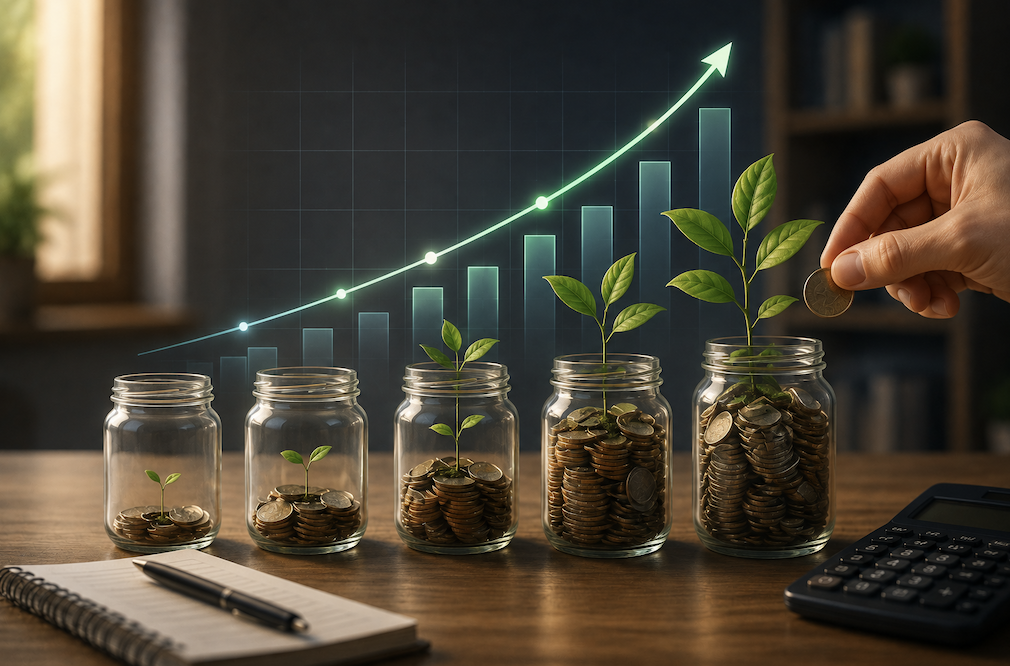
Compound interest gets described in nearly every personal finance conversation as one of the most powerful forces available for building wealth, and while that description sounds like a cliche, the underlying math genuinely supports it. Understanding exactly how compound interest works, and more importantly, how to actually put it to work in your own financial life, is one of the more valuable pieces of financial literacy you can develop.
The Basic Concept
Compound interest is interest calculated not just on your original amount of money, called the principal, but also on the interest that amount has already earned in previous periods. This creates a snowball effect, where your money grows at an accelerating rate over time, since each period’s interest calculation includes all the previously accumulated interest, not just the original principal.
This differs from simple interest, which calculates interest only on the original principal amount, regardless of how much interest has already accumulated. Simple interest grows at a steady, linear rate, while compound interest grows at an increasing rate over time, and this difference becomes dramatically more significant the longer the money remains invested or saved.
A Concrete Example
Imagine investing one thousand dollars at a five percent annual interest rate. With simple interest, you’d earn fifty dollars every single year, for a total of five hundred dollars in interest after ten years, bringing your total to fifteen hundred dollars.
With compound interest, calculated annually, the first year still earns fifty dollars, bringing your total to one thousand fifty dollars. But the second year’s interest is calculated on that new total, one thousand fifty dollars, not the original one thousand, earning fifty-two dollars and fifty cents rather than another flat fifty. This pattern continues, with each year’s interest calculated on an increasingly larger total, resulting in roughly sixty-three dollars in additional growth compared to simple interest over that same ten-year period, a gap that widens considerably further the longer the money remains invested.
Why Time Matters More Than Almost Any Other Factor
The genuine power of compound interest becomes most apparent over longer timeframes, which is exactly why financial advice consistently emphasizes starting to save and invest as early as possible, even with modest amounts, rather than waiting until you have a larger sum to start with. Money invested in your twenties has decades longer to benefit from compounding growth than the same amount invested in your forties, even if the later investment is a larger amount.
This is often illustrated by comparing two hypothetical savers: one who invests a modest amount starting in their twenties and then stops contributing entirely after a decade, versus another who starts investing a similar or even larger amount in their thirties or forties and continues contributing for many more years afterward.
Due to the extended time for compounding, the earlier, shorter-duration saver frequently ends up with a comparable or even larger total by retirement age, despite contributing less money overall, simply because their money had more total time to compound.
How Compounding Frequency Affects Growth
Interest can compound at different frequencies, annually, monthly, daily, or even continuously, depending on the specific account or investment. More frequent compounding results in slightly faster growth, since interest is being calculated and added to the principal more often, though the practical difference between monthly and daily compounding is generally fairly small for typical savings account balances. The bigger factor by far remains the interest rate itself and, especially, the total length of time the money remains invested or saved.
Where Compound Interest Works in Your Favor
Compound interest is the fundamental mechanism behind how savings accounts, certificates of deposit, and most long-term investments grow over time. Retirement accounts specifically benefit enormously from compound growth over the multi-decade timeframes typical of retirement saving, which is part of why starting retirement contributions as early as possible, even in relatively small amounts, is emphasized so consistently in financial planning advice.
Reinvesting dividends from stock investments, rather than withdrawing them as cash, is another common way people put compound growth to work, since reinvested dividends purchase additional shares, which then themselves generate further dividends going forward, compounding the growth over time in a way that withdrawing dividends as cash income doesn’t achieve.
Where Compound Interest Works Against You
The same mathematical principle that builds wealth when working in your favor works against you when you’re carrying debt that compounds, particularly high-interest debt like credit card balances. Just as compound interest on savings accelerates growth over time, compound interest on debt accelerates the total amount you owe if the balance isn’t paid down, which is exactly why carrying a balance on high-interest credit cards can become such a genuinely difficult financial situation to escape once it starts compounding significantly.
This is a key reason financial advice consistently emphasizes paying off high-interest debt aggressively, since the interest rate on much consumer debt is typically far higher than what you could reasonably expect to earn on equivalent savings or investments, making debt payoff frequently the better use of available money compared to saving, at least until high-interest debt is eliminated.
Practical Ways to Put Compound Interest to Work
Start saving and investing as early as possible, even in small amounts, since time is genuinely the most powerful variable in the compound interest equation and can’t be recovered once lost by waiting.
Choose accounts and investments with reasonable growth potential relative to your specific goals and risk tolerance, since a meaningfully higher interest or return rate compounds into a substantially larger difference over long timeframes. Reinvest dividends and interest rather than withdrawing them as cash whenever your financial situation allows it, letting the compounding process continue uninterrupted. And prioritize paying off high-interest debt aggressively, since compound interest working against you in the form of accumulating debt can undermine financial progress just as powerfully as it can build wealth when working in your favor.
Conclusion
Compound interest rewards patience and consistency far more than it rewards large, sporadic contributions made later. Understanding this genuinely changes how it makes sense to think about saving and investing, less about waiting until you have a large amount to start, and more about starting consistently as early as realistically possible, then letting time and compounding do a significant share of the remaining work.
- Read more about Newspinup
FAQ’s
1. Does compound interest apply to all types of savings accounts?
Most standard savings accounts, certificates of deposit, and money market accounts compound interest, though the specific rate and compounding frequency vary by account and institution. It’s worth checking the specific terms of any account to understand exactly how and how often interest compounds, since this information is typically disclosed clearly in the account’s terms or disclosure documents.
2. How can I calculate how much my money will grow with compound interest?
Online compound interest calculators, widely available for free, let you input your principal, interest rate, compounding frequency, and time horizon to see projected growth without needing to do the math manually. These are particularly useful for comparing different scenarios, such as starting to save at different ages or comparing different interest rates, to see the concrete impact of each variable.
3. Is a higher interest rate always better if I’m choosing between savings options?
Generally yes, all else being equal, since a higher rate compounds into meaningfully more growth over time. However, it’s also worth considering factors like accessibility of your money, any fees associated with the account, and how the rate compares to inflation, since a nominally higher rate doesn’t always translate to genuinely better real returns once these other factors are considered.
4. Why do financial advisors emphasize starting young even with small amounts?
Because time is the variable with the most dramatic impact on compound growth, and it’s the one variable that can never be made up for later. Someone who starts small in their twenties often ends up ahead of someone who starts with larger contributions later, purely because of how many additional years their money has had to compound, illustrating why starting early, even modestly, is emphasized so consistently.
5. Does compound interest work the same way with investments as it does with savings accounts?
The underlying mathematical principle is the same growth building on previous growth over time, though investment returns are typically less predictable and consistent than a fixed interest rate on a savings account. Reinvesting investment gains, particularly dividends, allows the same compounding effect to work in the investment world, generally over a longer time horizon given the added volatility compared to a guaranteed interest rate.
6. Can compound interest actually hurt me if I’m not careful?
Yes, specifically when it applies to debt rather than savings. A credit card balance carried month to month accrues compound interest on the unpaid amount, meaning the total owed can grow substantially faster than many people expect if only minimum payments are made. This is exactly why aggressively paying down high-interest debt is generally prioritized in financial advice over other savings goals, since the same compounding effect works against you in this context.
