


Travelling with only a carry-on bag removes some of the most common headaches of a trip, from waiting at the baggage belt to worrying about lost luggage. It also makes every transfer, staircase and cobbled street easier on your body and your nerves.
In this article we will explore how to pick the right bag, build a small wardrobe that works, handle liquids and electronics, pack efficiently and keep clothes fresh on the road, finishing with a clear plan for your next departure.
The real benefits of a lighter bag
Most people who switch to carry-on travel say the same thing afterwards: they never want to go back. The practical reasons are easy to list. You skip the check-in queue when your airline allows online check-in, you avoid the wait at the carousel, and you keep your belongings with you if a flight is delayed or rerouted. If your plans change at the last minute, you can hop onto an earlier train or flight without worrying about where your suitcase is.
There is a physical benefit too. A bag you can lift easily is a bag you can carry up a hostel staircase, onto a ferry or through a crowded station without strain. Anyone with back, shoulder or wrist problems should think carefully about how much weight they can carry comfortably, and a doctor or physiotherapist can give personal advice on safe loads. A lighter bag also means fewer choices each morning, which many travellers find calming.
There is a financial side as well, although it varies a great deal. Many airlines charge for checked bags, and some budget carriers charge for anything beyond a small personal item, so a smaller load can keep fares lower. Others include a cabin bag in every ticket. The sensible habit is to read the fare conditions at the time of booking, compare the total cost with and without a bag, and decide from there.
Finally, packing light forces you to think about what you really use. Most travellers return from a trip having worn only a fraction of what they brought. Treat the first few carry-on trips as experiments, and write down at the end what you wished you had left at home and what you wished you had brought. That short note becomes the foundation of a packing system that gets better every time.
Choosing the right bag and checking the rules
The bag matters more than almost any other decision. Cabin baggage limits differ between airlines, between fare types and between countries, and the stated dimensions often include wheels and handles. Before buying anything, find the size and weight allowance for the airlines you fly most often, and choose a bag that fits the smallest of them. If you fly several carriers on one itinerary, the strictest rule is the one that counts.
Soft-sided bags are forgiving because they can be squeezed into a tight sizer frame or an overhead locker, while hard-shell cases protect fragile items but cannot flex. Backpacks suit travellers who walk a lot or use uneven streets, and wheeled bags suit smooth airports and hotel corridors. Many people choose a hybrid with a padded harness that tucks away. Whichever style you prefer, look for a main compartment that opens wide, sturdy zips and a handle that does not wobble.
Weight rules are less visible than size rules but can be stricter, especially on regional and long-haul routes. Some airlines weigh cabin bags at the gate and some never do, so do not rely on luck. Weigh your fully packed bag on a home scale, and aim to land comfortably under the lowest limit you might meet. Remember that the personal item, such as a small backpack or tote, usually counts under a separate rule.
The table below gives a quick way to compare common bag types before you commit. Use it as a starting point, then test the bag you like in person if you can. Fit and comfort matter as much as the specifications.
| Bag type | Best for | Watch out for |
| Soft-sided wheeled case | Smooth airports and hotel hallways | Wheel and handle housing can eat into packing space |
| Bag type | Best for | Watch out for |
| Travel backpack | Walking, trains, uneven ground | Weight sits on your shoulders and back |
| Hard-shell spinner | Fragile items and rough baggage handling | Cannot squash into small sizers |
| Duffel with shoulder strap | Short trips and flexible lockers | Contents shift, and carrying comfort drops with weight |
Before you leave home, do a full test: pack the bag, lift it, carry it around the block, and lift it above head height as if loading an overhead locker. If you struggle, remove items now rather than at the airport. Keep your airline’s written rules on your phone in case staff at the gate need to see them.
Building a capsule wardrobe around three colors
A capsule wardrobe is simply a small set of clothing items that all go together. Start by choosing a base color, usually a neutral such as black, navy, grey or tan, then add one secondary color and one accent. Every top should work with every bottom, and every layer should work with every top. When this rule holds, six tops and three bottoms already make eighteen outfits.
Count your items according to the length of your trip, but cap the number at what you can wash in a sink. For a trip of a week or two, a common starting point is five or six tops, two or three bottoms, one lightweight layer, one warm layer, one outer shell, and enough underwear and socks for about four days. Longer trips do not need more clothes, only more laundry. That approach keeps the bag the same size whether you are away for four days or four weeks.
Choose fabrics as carefully as colors. Materials that resist wrinkles, dry quickly and do not hold odors save the most space and effort. Merino wool and many synthetic blends perform well here, while heavy cotton and thick denim take up room and dry slowly. Fabric care labels vary, so check each garment before you rely on it, and test a sink wash at home before you travel.
Finally, bring clothes you already like and know fit well. A trip is a poor time to try a new pair of shoes or an untested outfit. Lay everything out on the bed, remove one item from every category, and then ask whether each remaining piece can be worn at least twice and mixed with at least three others. Anything that fails the test goes back in the wardrobe.
Many travellers also like to keep a simple outfit formula so that decisions are made in advance. For example, you might pair a plain top with a patterned scarf one day, then swap in a different layer the next. Small accessories such as a belt, a hat or a lightweight scarf change the look of an outfit while taking almost no room. Choose them in your accent color so they match everything else you have packed.
Layering lets you handle changing weather without carrying a separate outfit for each temperature. The idea has three parts: a base layer that sits against your skin, a middle layer for warmth, and an outer shell that blocks wind and rain. In hot places, the base alone might be enough, and in cold ones you wear all three. Thin layers also pack far smaller than one thick coat.
The plane itself is a useful packing tool. Wear your heaviest shoes, your bulkiest jacket and your thickest trousers on travel days, because worn items do not count toward the bag’s volume, although airline weight rules apply only to what is in the bag. A scarf or wrap does double duty as an extra layer, a blanket on a cold flight and a privacy screen for napping. Keep a small layer within reach in your personal item, because cabin temperature varies from flight to flight.
Think about where you are going and what the season is likely to bring, using climate information from a reliable weather service or tourism board. Rain and cold change the plan far more than heat does, because wet clothes take up space and take time to dry. If rain is likely, a compact waterproof shell is more useful than an umbrella that may not survive the wind. If you will be near water, add a quick-drying swimsuit instead of a bulky towel, since most accommodations supply towels.
Shoes are the heaviest and bulkiest part of any wardrobe, so aim for no more than two pairs, or three if your trip includes hiking or formal occasions. One pair should be comfortable enough for a full day of walking, and the second should be light and flat enough to slide into a corner of the bag. Stuff socks, chargers and other small items inside the shoes so that the space does not go to waste. Put each pair in a bag or shower cap to keep dirt away from clean clothes.
Toiletries, liquids and small essentials
Liquids are where many packers lose the most space and the most patience. Security rules for liquids, gels and aerosols in hand luggage differ from country to country, but a widely used pattern is to restrict each container to a small size and to require all of them to fit together in one clear, resealable bag. Check the rules of the airports you will pass through, including any connections, before you leave. Rules can change, so look again a few days before departure.
The easiest way to reduce liquids is to swap them for solids. Bar shampoo, solid conditioner, toothpaste tablets, deodorant sticks and solid sunscreen sticks are all easy to find, take up little room and cannot leak. For liquids you cannot replace, use small reusable containers and fill them only about three-quarters full so they can handle pressure changes. Label each container, and press the air out of squeezable bottles before closing them.
Do not forget what you can buy on arrival. Most destinations sell everyday toiletries in pharmacies and supermarkets, so a week-long trip rarely needs a stockpile. If you use prescription medicine, always carry it in your hand luggage in its original packaging, keep a copy of the prescription, and check the rules of your destination country, since some medicines are restricted. Speak to your doctor or pharmacist about timing, supply and travel advice before any long trip.
A small kit of practical extras prevents small problems from becoming large ones. Most of these items weigh almost nothing. Consider adding the items in the table below, adjusting them to your own health needs and the length of your trip.
| Category | Examples | Notes |
| Health | Plasters, pain relief you normally use, any personal medicine | Keep medicine in original packaging and in hand luggage |
| Hygiene | Travel toothbrush, floss, small comb | Choose solid or refillable formats |
| Laundry | Travel wash, sink stopper, clothesline | Check that detergent counts under liquid rules |
| Repairs | Needle, thread, safety pins | Scissors and blades may be restricted, so check |
Electronics, documents and the personal item
Electronics add weight quickly, so take only what you will use. A phone often replaces a camera, a guidebook, a map, a boarding pass and a music player, and a single lightweight charger can cover several devices. Choose one cable type for everything if you can. Pack a power adapter for the countries on your route, since plug shapes and voltages vary, and check that your devices accept the local voltage before you plug them in.
Keep valuable and fragile items in your personal item, where you can see them. Lithium batteries and power banks are often subject to special rules, and airlines commonly require them to travel in cabin baggage rather than in the hold. Because rules differ, check your airline’s dangerous-goods guidance before you fly. Switch devices off completely for security checks, and keep them easy to remove if the airport asks you to place them in a tray.
Documents deserve their own pouch. Gather your passport or identity card, visas if needed, travel insurance details, accommodation addresses, booking confirmations and emergency contacts. Entry requirements and passport validity rules differ by country, so confirm them with the official government travel pages of your own country and your destination well before you travel. Keep digital copies in secure storage and a paper copy in a different part of your luggage, in case a phone is lost or the battery dies.
Finally, plan what goes in the personal item by thinking about the first few hours of the journey. Water bottle (empty through security), snacks, a change of underwear, a light layer, headphones, a pen for customs forms and a book or downloaded entertainment are all worthwhile. Anything that you might need during a delay belongs here rather than in the overhead locker. A tidy personal item lets you stay calm when plans change.
Packing methods that save space
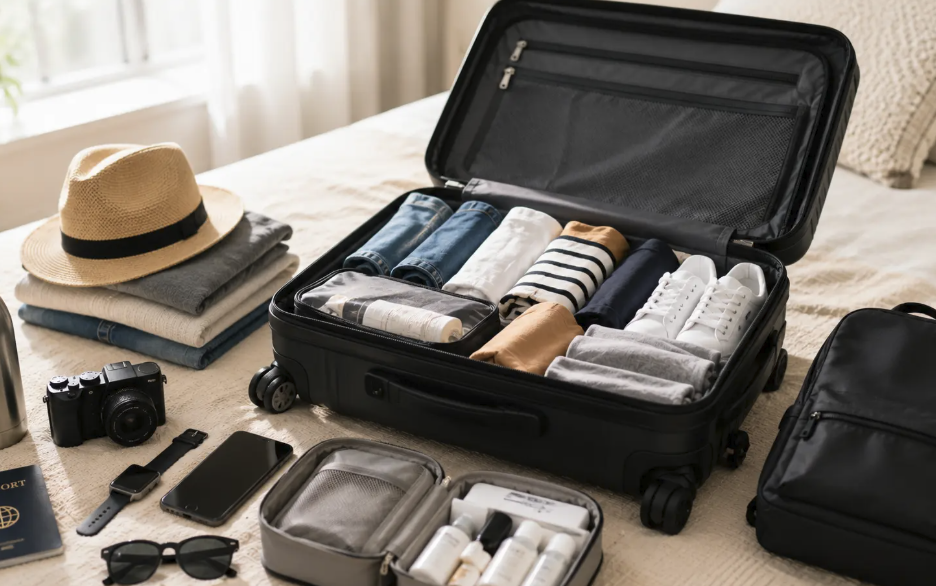
There are several well-known methods for arranging clothes, and the best one depends on the fabrics you are carrying. Rolling works for casual items such as T-shirts, underwear and thin knitwear, and it makes it easy to see each piece at a glance. Folding suits stiffer garments such as shirts and trousers, which can crease when rolled tightly. Bundling wraps clothes around a soft core and can reduce creases in formal wear, but it takes practice.
Packing cubes or lightweight pouches are among the most popular tools among frequent travellers, and for good reason. They keep categories together, compress soft items slightly and let you take out one section without unpacking the whole bag. Compression bags can reduce volume further, but they make it easy to exceed the weight limit, so weigh the bag after using them. Even simple zip bags from the kitchen drawer work if you do not wish to buy anything new.
Weight distribution matters as much as space. For a wheeled bag, put heavy items such as shoes and toiletries near the wheels so the bag stays stable when tilted. For a backpack, place the heaviest items close to your back and between the shoulder blades, which keeps the load balanced. Fill gaps with socks and underwear, and leave the top of the bag flexible so you can add a purchase or a jacket at the end.
Try this simple order each time you pack. Start with shoes at the base, add the heaviest flat items, then the folded or rolled clothing, then the soft layers, and finally the small items on top. Zip the bag, shake it gently, and open it again to check nothing has moved. Take a photo of the packed bag to help you repack quickly and notice anything missing.
Another useful habit is to pack in two zones. Keep one zone for items you will use every day, such as underwear, a phone charger and your toiletry bag, and a second zone for items you may use only once, such as a formal shirt or a swimsuit. When you arrive, unpack the daily zone into a drawer or onto a shelf and leave the rest in the bag. That keeps the bag tidy, makes repacking easy, and means you never have to turn everything out to find a single sock.
Washing and refreshing clothes on the road
The true secret of packing light is laundry. Rather than carrying a fresh outfit for every day, plan to wash a few items every three or four days. A sink or shower tray, a small amount of travel wash or ordinary soap, and a few minutes are enough. Wash in warm water if the label allows it, squeeze rather than wring, and roll the item in a towel to remove most of the water before hanging it.
Fabric choice makes this routine far easier. Thin synthetics and merino blends usually dry overnight in a room with some airflow, while heavy cotton can take a day or more. Plan to wash in the evening so the clothes can dry while you sleep. A short clothesline or a few plastic hangers help, and a bathroom fan or a window crack improves drying. Avoid hanging wet clothes in a closed bag, because they can develop odors.
Self-service laundries and hotel laundry services are another option, especially on longer trips. Self-service laundries are common in many cities, but opening hours, machines and costs vary by country, so check locally. Hotel laundry service is usually convenient but often priced per item, so it suits only a few pieces. If you use a laundry, keep a spare outfit for the wash day and use a small mesh bag so socks do not go missing.
Between washes, you can freshen clothes without water. Hang them in the open air, steam them in the bathroom while you shower, and spot-clean stains straight away with a damp cloth. Wool items resist odors, so they can be worn several times before washing. Rotate your garments so that no single item is worn every day.
Moving through airports and transit with one bag
Travel day goes more smoothly when you treat the bag as part of a routine. Before you leave the accommodation, do a quick sweep of the room, the bathroom and the power sockets, because chargers are the item most often left behind. Check the bag zips, make sure the airline tag or any name label is attached, and put your passport, phone and wallet in the same pocket every time. A fixed home for each item means you never search through the bag in a queue.
At the airport, wear the clothes that are easiest to take off and put on, such as slip-on shoes and a jacket with deep pockets. Place the clear liquids bag, any laptop or tablet and your coat where you can reach them quickly. Empty your pockets into the bag before you reach the screening point, so that you are not holding up the line. If your bag is chosen for an extra check, stay calm, answer questions politely and let staff handle the contents.
Boarding is the moment when cabin space becomes tight. Airlines often board by group or fare type, and overhead lockers fill from the front, so the smaller your bag the less you depend on a good seat. Place your carry-on with the wheels or handle facing the way the crew requests, and keep the personal item under the seat in front. If the flight is full, the crew may ask to move a cabin bag to the hold at no charge, so keep valuables, medicine and documents in the personal item for exactly that reason.
On trains, buses and ferries, a compact bag is a real advantage because luggage racks vary in size and security. Keep the bag within sight on busy services, use a small lock on zips in crowded places, and keep a copy of your accommodation address on paper. Rules about bag size and weight on rail and coach services differ by operator and country, so check them when you buy tickets. A light bag also lets you walk when public transport is disrupted.
Conclusion
If you are new to carry-on travel, begin well before the night before departure. A week ahead, check your airline’s cabin and personal item rules, confirm your destination’s entry rules and security regulations for liquids, and check the weather outlook. That single session removes most of the uncertainty and lets you choose clothing with confidence. Write the plan down so you can adjust it rather than starting again.
Three days ahead, lay out everything you think you need on a bed or floor, then edit hard. Remove at least one item from each category, check that every piece mixes with at least two others, and set aside what you will wear on the plane. Then pack in the order described earlier, weigh the bag, and carry it around your neighborhood to check it feels manageable. If anything feels heavy, take more out.
On the day of travel, keep documents, medicine, valuables and a light layer in the personal item, and leave extra time for security in case your bag is selected for a check. Keep a small space free for purchases, or plan to post a parcel home if you expect to buy a lot. After the trip, spend five minutes writing down what you used, what you did not, and what you would change next time. Over a few trips that record turns packing from a chore into a quick, confident routine.
