


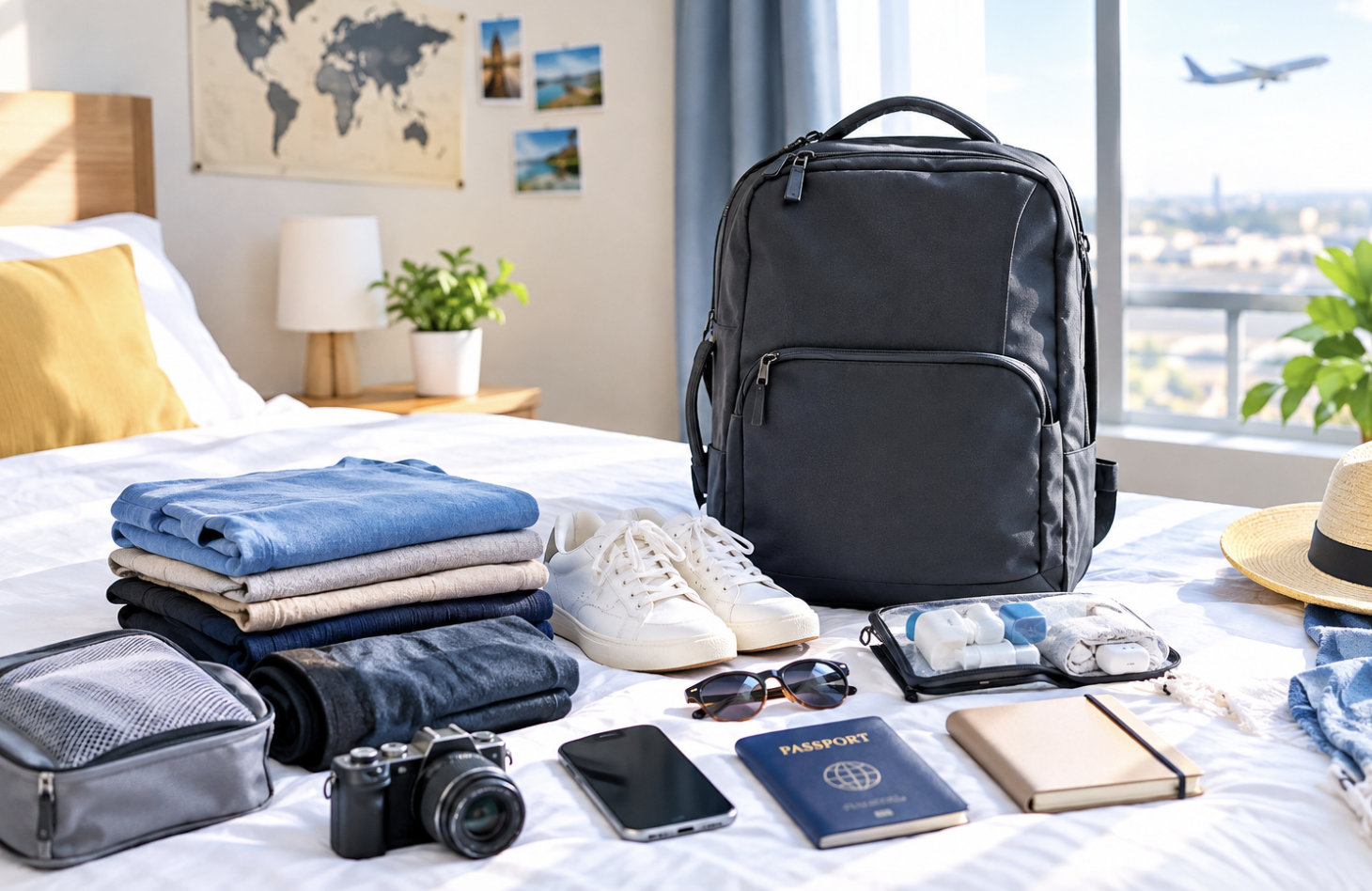
There’s a particular kind of freedom that comes from walking through an airport with a single bag slung over your shoulder while everyone else wrestles oversized suitcases toward the check-in counter. One-bag travel, sometimes taken to its logical extreme with trips lasting weeks or even months using nothing but a single backpack or carry-on, has grown from a niche practice among a small group of dedicated minimalists into something a much broader range of travelers genuinely aspire to.
It turns out that packing lighter isn’t really about deprivation. It’s about being deliberate, understanding what you actually need versus what you merely think you might need, and building a system that removes decision fatigue rather than adding restriction to your trip.
Why One-Bag Travel Appeals to So Many People
Beyond the obvious practical benefits, skipping baggage claim, avoiding checked bag fees, moving faster through crowded transit hubs, there’s a less tangible but equally real benefit that experienced one-bag travelers consistently mention: a reduction in mental overhead. When everything you own for a trip fits into a single, manageable bag, you’re never anxious about losing track of a second or third piece of luggage, you’re never straining to lift something heavy onto an overhead rack, and you’re never standing at a hotel room door juggling multiple bags while trying to find your key card.
The simplicity extends beyond the physical logistics into a genuine sense of freedom that many travelers say fundamentally changes how relaxed they feel throughout an entire trip, not just during the transit portions.
There’s also a financial angle that matters more than people initially expect. Between checked bag fees on many airlines, the risk of paying for lost luggage replacement in a worst-case scenario, and the simple time savings of never waiting at a baggage carousel, one-bag travel pays for itself in ways beyond the upfront cost of good gear.
Choosing the Right Bag Is the Foundation
Before getting into what to pack, the bag itself deserves serious consideration, since it’s the single piece of equipment your entire system will be built around. For most one-bag travelers, this means either a well-designed travel backpack in the thirty-five to forty-five liter range, or a structured carry-on suitcase that meets most airlines’ size restrictions.
Backpacks offer genuine advantages for travelers who anticipate walking significant distances, navigating uneven terrain like cobblestone streets or unpaved paths, or generally wanting both hands free rather than pulling a rolling bag behind them. Look specifically for a backpack with a structured internal frame that helps distribute weight properly across your hips rather than entirely on your shoulders, since carrying weight incorrectly over a long day of walking can turn into genuine discomfort by the end of a travel day.
A structured carry-on suitcase, by contrast, tends to work better for travelers whose trips involve mostly city environments with reasonably smooth surfaces, hotel stays rather than hostels or more rugged accommodations, and situations where rolling a bag genuinely is more convenient than carrying it on your back. The rigid structure of a good hardshell or semi-structured softshell carry-on also protects fragile items better than a soft-sided backpack typically can.
Whichever style you choose, prioritize a bag that meets the carry-on size restrictions of the airlines you fly most frequently, since these restrictions vary meaningfully between full-service carriers and budget airlines, with budget airlines in particular often enforcing stricter limits and charging aggressively for bags that don’t comply.
The Capsule Wardrobe Approach
The single most impactful shift in mindset for successful one-bag travel is moving away from packing individual outfits and instead building a small, deliberately coordinated wardrobe where every item works with every other item. Rather than thinking “what will I wear on day three,” think “what colors and styles can I choose that all combine seamlessly with each other.”
Start by choosing a base color palette, typically two neutral tones like navy and gray, or black and beige, that provide a foundation every other piece can build from. From there, select a small number of versatile pieces: three to four bottoms that work for a range of occasions, five to six tops that mix and match freely with those bottoms, one mid-layer like a cardigan or lightweight sweater, and one outer layer suited to your destination’s likely weather.
This might sound restrictive on paper, but the actual number of unique outfit combinations this creates is genuinely surprising, often reaching into the dozens of distinct looks from what amounts to a dozen or so total garments.
Fabric choice matters as much as the specific garments you choose. Look for wrinkle-resistant, quick-drying materials that hold up well to being worn multiple times between washes without looking or smelling stale. Merino wool has become something of a cult favorite among serious minimalist travelers specifically because it naturally resists odor even after multiple wears, regulates temperature well across a range of conditions, and packs down into a remarkably small space relative to its warmth and durability.
Rethinking Shoes, the Biggest Space Consumer
Shoes consistently take up more proportional space in a travel bag than any other single category of item, and it’s tempting to pack a different pair for every conceivable scenario, walking shoes, dress shoes, sandals, athletic shoes.
For genuinely minimalist one-bag travel, limiting yourself to two, or at most three, pairs of shoes total is essential, and choosing versatile options that each serve multiple purposes matters considerably more than optimizing any single pair for one specific narrow use case.
A comfortable, somewhat versatile walking shoe that can handle both casual daytime activity and a slightly dressed-up evening, paired with either a lightweight pair of sandals or a compact pair of athletic shoes depending on your specific trip’s activities, covers the overwhelming majority of realistic travel scenarios. Wearing your bulkiest pair of shoes while actually traveling, rather than packing them, freesup meaningful space inside your bag for everything else.
Packing Cubes and Compression as Genuine Tools, Not Just Organization
Packing cubes have become something of a cliché in travel advice, but they earn their reputation through genuine functional benefit rather than simply looking neat in social media photos. Beyond keeping categories of items separated and easy to locate without unpacking your entire bag, compression-style packing cubes, which include a secondary zipper that squeezes excess air out of the cube once packed, meaningfully reduce the physical volume that soft items like clothing actually occupy inside your bag.
For genuinely minimalist packing, this compression effect isn’t a minor convenience, it’s often the difference between everything fitting comfortably and needing to make difficult last-minute decisions about what to leave behind.
Organizing by category, one cube for tops, one for bottoms, one for undergarments and socks, also means you’re never digging through your entire bag’s contents to locate one specific item, which matters considerably more after several days of travel when your bag’s internal organization has otherwise started to become chaotic.
Toiletries: The Overlooked Space Drain
Full-sized toiletries are one of the most common reasons otherwise careful minimalist packers still end up over capacity. Solid alternatives, shampoo bars, solid conditioner, solid perfume, toothpaste tablets, eliminate the liquid restrictions entirely while taking up meaningfully less space than their liquid counterparts.
For products without a solid alternative you’re comfortable with, refillable travel-sized containers, filled from your regular full-sized products at home, let you bring exactly the quantity you’ll actually need rather than carrying an entire full-sized bottle for a trip that will only use a fraction of it.
Remember also that most accommodations, hotels in particular but increasingly many hostels as well, provide basic toiletries like shampoo, conditioner, and body wash, meaning you often don’t need to bring your own at all unless you have a specific product preference that matters enough to justify the extra space.
Electronics and the Temptation to Overpack Gadgets
It’s easy to accumulate a surprising amount of weight and bulk in electronics and their associated cables, chargers, and adapters. Before a trip, honestly assess which devices you’ll actually use regularly versus which ones you’re bringing on the theoretical chance you might want them.
A single multi-port charging cable or a compact multi-device charging block can often replace several separate chargers, and consolidating cables into a single small organizing pouch, rather than letting them float loosely throughout your bag, both saves space and prevents the frustration of digging through a tangle of cords every time you need to charge something.
Building Your Personal Packing List Through Iteration
The truth that experienced one-bag travelers will tell you honestly is that nobody nails their ideal packing list on the very first attempt. The process genuinely improves through iteration, packing for a trip, noticing afterward what you actually used regularly versus what sat untouched in your bag the entire time, and adjusting your approach for the next trip based on that honest reflection.
Keeping a simple note after each trip, what worked, what you wished you’d brought, what you never touched and could have left behind, builds a genuinely personalized packing system over time that reflects your actual travel style rather than someone else’s generic recommendations.
Addressing the Common Worry About Not Having Enough
The most common psychological barrier to successful minimalist packing isn’t logistics, it’s an underlying anxiety about being caught without something you might need. It’s worth directly confronting this concern: in the vast majority of destinations, especially anywhere with reasonable infrastructure, you can purchase almost anything you might have forgotten or genuinely need once you arrive, often for a similar or even lower price than at home.
This reframe, that packing light doesn’t mean permanently going without something, just deferring the decision to actually need and purchase it if the situation genuinely arises, removes much of the anxiety that leads to overpacking in the first place.
Making Peace With Wearing the Same Things Repeatedly
A final psychological hurdle worth addressing directly is the concern about wearing the same limited wardrobe repeatedly, which can feel uncomfortable if you’re used to a much larger closet at home. In practice, most experienced minimalist travelers report that this concern fades quickly once actually traveling, partly because you’re generally around different people in each new location who haven’t seen your previous outfits, and partly because the genuine benefits of lighter, simpler travel quickly outweigh whatever social self-consciousness initially existed around repeating outfits more frequently than you might at home.
Conclusion
Building a genuinely successful one-bag travel system starts with choosing the right bag for your specific travel style, then committing to a coordinated, versatile capsule wardrobe built around a limited color palette. Layer in compression packing cubes for organization and space efficiency, minimize shoes to two or three genuinely versatile pairs, choose solid or refillable toiletries over full-sized liquid products, and consolidate your electronics down to what you’ll actually use regularly.
Most importantly, treat your first attempt as a starting point rather than a finished system, refining your approach through honest reflection after each trip until you’ve built a packing method that genuinely fits how you actually travel, rather than an idealized version borrowed entirely from someone else’s list.
Frequently Asked Questions
1. Is one-bag travel realistic for a trip longer than a couple of weeks?
Yes, and many dedicated minimalist travelers regularly travel for months at a time with a single bag. The key shift for longer trips is planning around laundry rather than packing enough clothing to avoid it entirely. Most accommodations, from budget hostels to mid-range hotels, offer some form of laundry service or at minimum a sink for hand-washing a few items, and building this into your routine, roughly once every week to ten days, removes the need to pack substantially more clothing for a longer trip than you would for a shorter one.
2. What if my trip includes very different climates or activities?
Layering is the most practical solution here rather than packing entirely separate wardrobes for different conditions. Choosing pieces that combine into different levels of warmth, a base layer, a mid layer like a light sweater, and a packable outer shell, covers a much wider range of temperatures than packing bulkier, single-purpose cold-weather or warm-weather items. For genuinely divergent activities within a single trip, business meetings followed by an outdoor adventure segment, for example, focus on a small number of versatile pieces that can be dressed up or down rather than dedicated outfits for each distinct activity.
3. How do frequent one-bag travelers handle special occasions requiring dressier clothing?
Most minimalist travelers include one slightly dressier outfit option specifically chosen for its ability to be dressed up with minor additions, a different pair of shoes, simple jewelry, rather than packing an entirely separate formal outfit that only serves one narrow purpose. If a trip involves a specific, predictable formal event, it’s reasonable to pack one dedicated piece for that occasion, but building your everyday wardrobe with enough versatility that most moderately dressy situations can be handled without a special outfit reduces the need for this kind of single-purpose packing in the first place.
4. Is checked luggage ever the better choice despite the appeal of one-bag travel?
Certainly, for specific circumstances. Trips involving specialized equipment, professional gear, medical equipment, or particular souvenirs and purchases you know you’ll be bringing home, may genuinely require more space than a single carry-on bag can accommodate. One-bag travel is a strong default for many trips, but treating it as a rigid rule rather than a generally useful approach can create unnecessary stress in situations where checked luggage is simply the more practical, sensible choice.
5. How much does a quality travel backpack or carry-on typically cost, and is it worth the investment?
Quality options exist across a range of price points, though genuinely well-designed travel bags with a durable structure, comfortable weight distribution, and thoughtful organizational features tend to sit in a moderate to premium price range compared to basic luggage. For anyone planning to travel more than occasionally, this is generally considered a worthwhile investment, since a well-made bag typically lasts for many years of regular use and meaningfully improves the actual physical comfort and organization of every trip taken with it, compared to a cheaper bag that may need replacing after a much shorter period of regular use.
6. What’s the biggest mistake people make when first trying one-bag travel?
Packing for imagined scenarios rather than realistic ones is by far the most common mistake. It’s easy to pack an extra outfit “just in case” of a spill, a specific shoe for an activity you’re not actually certain you’ll do, or a heavier jacket for weather that’s only a remote possibility based on your actual itinerary and research. Being genuinely honest with yourself about your confirmed plans, rather than every hypothetical situation you can imagine, is what ultimately makes minimalist packing achievable without constant anxiety about being underprepared.
