


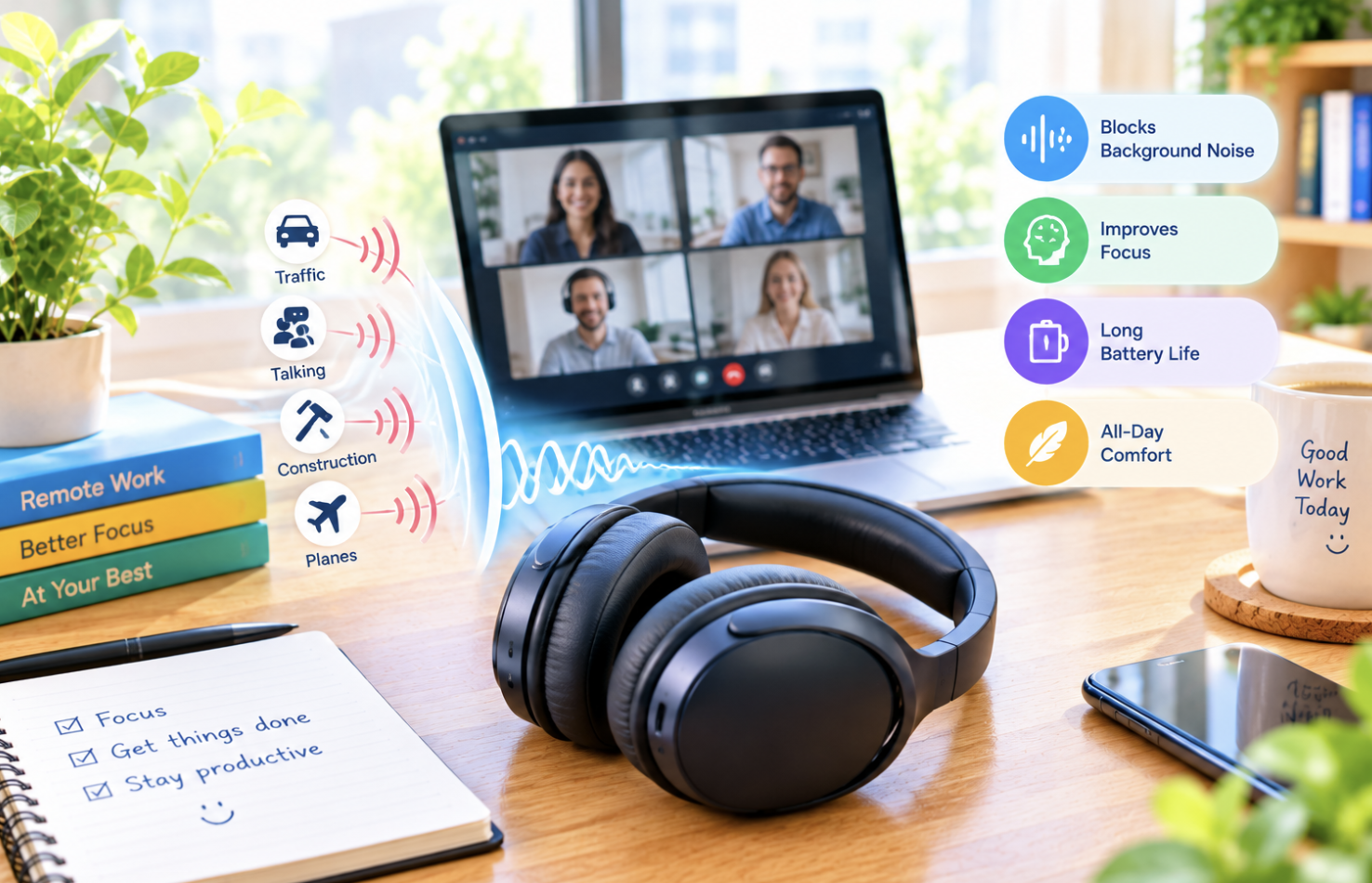
Working from home sounds like it should be quieter than an office, but for a lot of people it isn’t barking dogs, construction noise, roommates or family members, traffic outside a window that never quite closes all the way. Noise-cancelling headphones have become one of the more practical investments remote workers make, not for entertainment but for protecting focus and improving call quality throughout a workday.
What actually matters when choosing a pair, beyond marketing claims, helps you find something that fits your specific work environment rather than overpaying for features you won’t use or underbuying on something that won’t solve your actual problem.
How Noise Cancellation Actually Works
Active noise cancellation uses microphones to detect ambient sound and then generates an inverse sound wave to cancel it out before it reaches your ear, which is meaningfully different from simple passive noise isolation, which relies purely on the physical seal of ear cups or ear tips blocking outside sound.
Active noise cancellation is generally more effective against low, constant frequencies, like the hum of an air conditioner, a plane engine, or general background rumble, while it’s less effective against sudden, sharp, or highly variable sounds, like a dog barking or someone talking nearby.
This distinction matters because it shapes realistic expectations. Noise-cancelling headphones reduce a lot of distracting ambient noise, but they don’t create complete silence, and marketing claims suggesting otherwise tend to oversell what the actual technology reliably delivers in a home work environment.
Over-Ear vs In-Ear: Which Fits Your Situation
Over-ear headphones generally provide more effective noise cancellation due to their larger ear cups creating a better physical seal and having more room for larger, more effective drivers and noise-cancelling components. They’re also generally more comfortable for extended wear throughout a full workday, since the weight is distributed across a larger surface area rather than concentrated inside your ear canal.
In-ear options, particularly true wireless earbuds with active noise cancellation, offer more portability and discretion, useful if you move between different workspaces throughout your day or simply prefer a lower profile than a full over-ear headset.
Noise cancellation performance in earbuds has improved significantly in recent years and can now rival over-ear options in some premium models, though budget in-ear options still generally lag behind comparable over-ear alternatives in this specific area.
Prioritize Microphone Quality for Video Calls
For remote work specifically, the actual audio you produce matters just as much as what you hear, since a significant portion of most remote workers’ headphone use involves video and voice calls where colleagues need to hear you clearly.
Headphones marketed primarily toward general noise cancellation for travel or commuting don’t always prioritize microphone quality to the same degree as options specifically designed with remote work and calls in mind.
Looking specifically for reviews or specifications addressing microphone clarity, background noise reduction on your own voice transmission during calls, and multi-microphone arrays designed to isolate your voice from ambient background noise matters considerably for remote work use, even if it’s a secondary consideration for headphones designed primarily around music or general noise cancellation.
Consider Battery Life and Charging Convenience
For all-day remote work use, battery life becomes a practical consideration in a way it might not be for someone using headphones for a shorter daily commute. Look for options offering enough battery life to comfortably cover a full workday of calls and focused work without needing a mid-day charge, and consider whether quick-charging capability, providing a few hours of use from a brief charging session, matters for your specific situation if you do occasionally run low during a workday.
For wireless earbuds specifically, checking the total battery life including the charging case, not just a single charge, gives a more accurate picture of how many charges you’ll realistically get before needing to plug in the case itself.
Comfort Matters More for All-Day Wear Than for Casual Use
Headphones reviewed primarily for weekend or commuting use often aren’t evaluated specifically for the comfort demands of wearing them for six, seven, or eight hours consecutively throughout a workday. Look for reviews or specifications addressing extended wear comfort specifically, clamping force that isn’t too tight, breathable ear cushion materials, and overall weight, since even small discomforts become bothersome after several consecutive hours rather than the shorter listening sessions many headphones are originally designed and marketed around.
Trying headphones in person if possible, or at minimum checking a retailer’s return policy if buying online, gives you a reasonable safety net if a specific model turns out to be uncomfortable for your particular ear shape or head size once you’ve actually worn it for an extended period.
The Price and Feature Tradeoffs
Premium noise-cancelling headphones from well-established audio brands generally deliver noticeably better noise cancellation performance, sound quality, and build quality compared to budget options, but the price difference is often substantial, and the improvement isn’t always linear relative to the added cost.
Mid-range options from reputable brands frequently deliver solid performance across noise cancellation, call quality, and comfort at a considerably lower price than the most premium flagship models, making them a reasonable choice for most remote workers who don’t have highly specialized needs.
Budget options exist as well, and while noise cancellation performance is typically noticeably weaker than mid-range or premium alternatives, they can still provide meaningful improvement over no noise cancellation at all, worth considering if cost is a significant constraint and some improvement is preferable to none.
Think About Your Specific Noise Environment
The right choice depends significantly on what specific noises you’re actually trying to address. If your primary issue is constant background hum, traffic, appliances, general ambient noise, strong active noise cancellation addresses this effectively.
If your primary issue is more about not disturbing others or not being disturbed by conversational noise from people talking nearby, a good physical seal combined with noise cancellation, or even simply headphones that let you comfortably listen to background sound like white noise or music to mask distracting conversation, might matter more than maximizing pure noise cancellation performance alone.
Being honest about your specific distraction sources, rather than assuming maximum noise cancellation automatically solves every possible noise problem, helps you prioritize the features that will actually address your particular work-from-home environment.
Conclusion
Start by identifying your specific noise challenges and whether over-ear or in-ear format better fits how you actually work throughout your day. Prioritize microphone quality specifically for call clarity, given how central video and voice calls are to most remote work. Check battery life against your actual daily usage patterns, and pay attention to extended-wear comfort reviews rather than only general audio quality assessments.
Choosing based on these practical, remote-work-specific factors, rather than simply the most heavily marketed or most expensive available option, tends to result in headphones that improve your daily work experience rather than delivering impressive specifications that don’t actually address your real day-to-day needs.
Frequently Asked Questions
Does noise cancellation drain battery life significantly faster than using headphones without it enabled?
Yes, active noise cancellation does consume additional battery power compared to using headphones with the feature turned off, though the actual impact varies by specific model and how efficiently its processing is designed. If you’re finding battery life shorter than expected, checking whether noise cancellation is set to its maximum strength unnecessarily, when a lower setting might still adequately address your specific environment, can help extend battery life somewhat.
Can noise-cancelling headphones cause any discomfort like ear pressure?
Some users report a mild pressure or fullness sensation from active noise cancellation, particularly with over-ear headphones creating a strong seal, though this varies significantly by individual and specific headphone model. If you experience this, trying a different model with adjustable noise cancellation strength, or an option known for a more subtle cancellation effect, can help identify whether the issue is specific to noise cancellation technology generally or particular to that specific headphone’s implementation.
Is it worth paying significantly more for the top flagship model from a major brand?
For most remote workers, a well-reviewed mid-range option delivers most of the practical benefit needed for daily work use, noise cancellation, call quality, and comfort, without the substantial additional cost of the most premium flagship models. The added cost of top-tier options often goes toward marginal audio quality improvements more relevant to serious audiophiles or premium sound quality use cases than to the practical, work-focused needs most remote workers actually have.
How do I know if my current headphones’ microphone is actually a problem during calls?
Asking colleagues directly for honest feedback about your audio quality during calls is the most reliable way to identify this, since it’s difficult to judge your own microphone quality from your own perspective. Recording a short test clip and listening back, or using a call-testing feature many video conferencing platforms offer before joining a meeting, can also help you identify whether background noise or voice clarity issues are present before they become a repeated problem during actual important calls.
Should I buy headphones with both wired and wireless connectivity options?
This can be a useful feature if you occasionally need a completely reliable connection for an important call and want to avoid any risk of wireless connectivity issues, or if you want the flexibility to use the headphones with older equipment that lacks Bluetooth. For most remote workers with modern equipment, wireless-only options work perfectly well, but the added flexibility of wired backup capability is a reasonable feature to prioritize if call reliability during high-stakes meetings is a significant concern for your specific role.
